
On December 24, 2025, a mob in Hosendanga, Rajbari district, beat 29-year-old Hindu man Amrit Mondal to death. Eight days earlier, Dipu Chandra Das was burned alive over false blasphemy accusations.
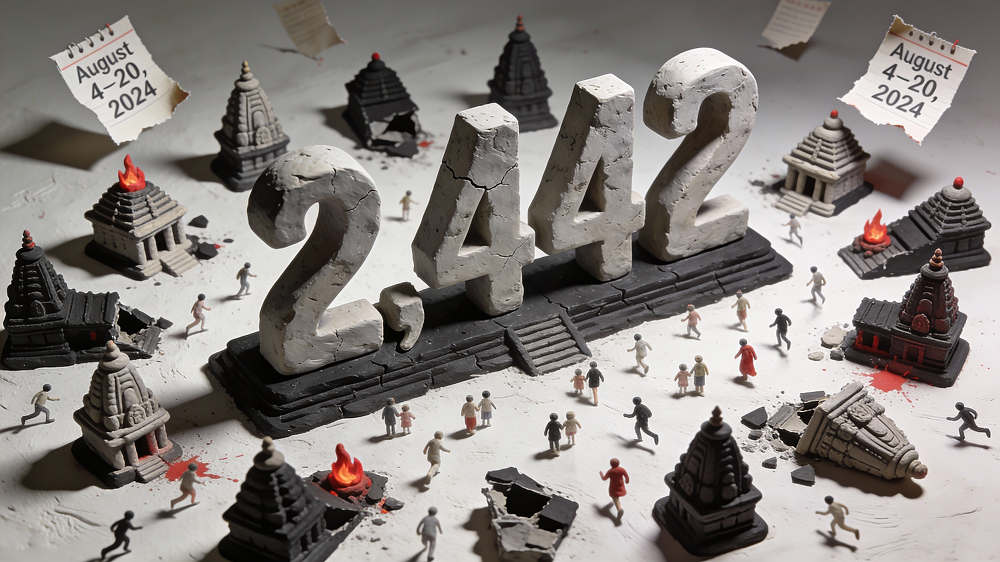
These killings represent a documented crisis: 2,442 violent attacks against Hindu communities between August 2024 and June 2025, resulting in 25 deaths and 69 destroyed temples, according to the Bangladesh Hindu Buddhist Christian Unity Council.
What began as political upheaval following Sheikh Hasina’s August 2024 resignation has escalated into what human rights observers describe as systematic religious targeting—the worst communal violence Bangladesh has witnessed since 1971.
December 2025: Locked-Door Arson Attacks Escalate
Seven Hindu homes were set ablaze over five days in the Raozan area of Chattogram. The attackers employed a systematic terror tactic: they locked families inside before igniting the structures, forcing victims to cut through walls to escape. A threatening banner found near one of the sites warned Hindu residents of “severe consequences” if they continued their “activities against Islam.”
In addition, three more homes were burned in Pirojpur on December 27. Ain o Salish Kendra documented 184 deaths due to mob violence in Bangladesh during 2025. While India expressed “serious concern,” Bangladesh dismissed the criticism as “motivated narratives,” labeling the attacks as “isolated criminal acts.” A survivor of the violence stated, “We survived this time. But we don’t know about the next fire.”
The Numbers That Expose a National Crisis
Is the violence against Hindus in Bangladesh really that bad? The numbers tell a clear story. According to the Bangladesh Hindu Buddhist Christian Unity Council’s July 2025 report, here’s what happened:
August 4-20, 2024: The Initial Wave
The period immediately following Sheikh Hasina’s resignation saw:
- Over 1,000 documented attacks in 16 days
- 69 temples damaged or destroyed
- 157 families’ homes ransacked, looted, or burned
- 5 Hindu community members killed, including at least 2 confirmed Awami League members
- 1,068 houses and businesses were attacked
Total Violence (August 2024-June 2025)
- 2,442 documented incidents
- 25 deaths reported by human rights organizations
- 2,184 attacks between August and December 2024
- 92 additional attacks were documented between January and February 2025
“What we have witnessed represents systematic targeting of Bangladesh’s minorities, particularly Hindus,” said Narmal Rosario, senior member of the Bangladesh Hindu Buddhist Christian Unity Council.

Why Bangladesh Lost 70% of Its Hindu Population
Where did all the Hindus go? Census data from Bangladesh reveals a shocking decline over seven decades. In 1947, nearly 1 in 4 people in Bangladesh (then East Pakistan) were Hindu. Today? Less than 1 in 12.
| Year | Hindu Population Percentage | Context |
|---|---|---|
| 1947 | ~22-24% | Partition baseline |
| 1951 | 22% | East Pakistan census |
| 1974 | 13.4% | Post-1971 conflict |
| 2022 | 7.95% | Current census |
Human rights organizations note that multiple factors have contributed to this decline, including migration, economic pressures, property disputes, and episodes of communal violence during political transitions.
Documented Patterns of Vulnerability
Human rights researchers have identified several structural factors that contribute to the vulnerability of Hindu communities in Bangladesh:
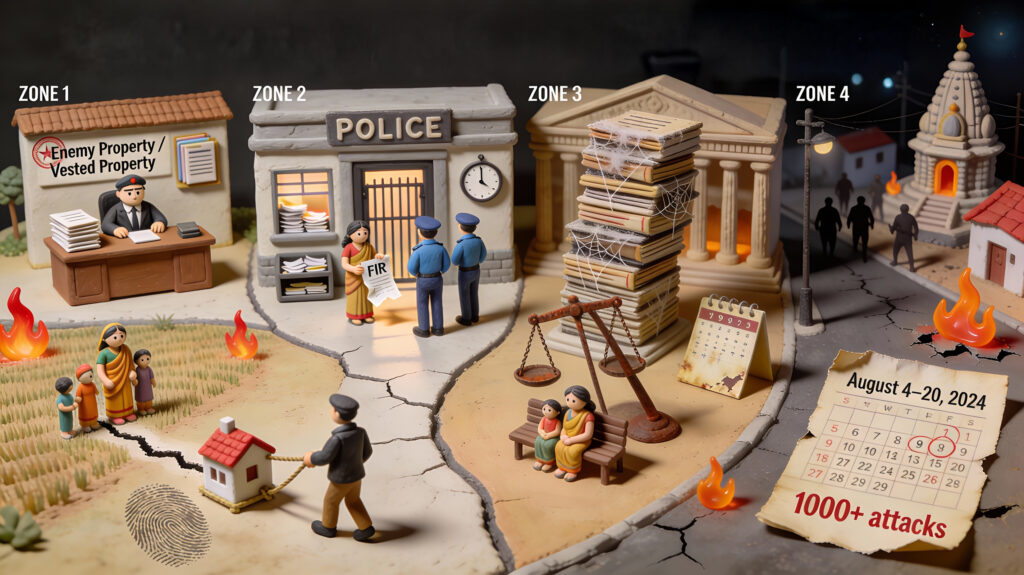
Property Laws and Land Disputes
Historical legislation, including the Enemy Property Act (later renamed Vested Property Act) has been cited in numerous cases where Hindu families lost ancestral land. Research indicates these laws were applied disproportionately, creating economic pressure on minority communities.
Law Enforcement Response
Multiple human rights reports document instances where police have been slow to register First Information Reports (FIRs) following attacks on Hindu families and properties. Delayed or inadequate police response has been cited as a factor that emboldens perpetrators.
Judicial Delays
Cases involving communal violence often face significant delays in the court system, sometimes spanning years. Extended legal proceedings exhaust resources for victims while allowing accused individuals to remain free.
Violence During Political Transitions
Historical analysis shows spikes in anti-Hindu violence during periods of political instability. The August 2024 pattern of over 1,000 attacks in 16 days following governmental change fits this established pattern.

Political Context: The August 2024 Transition
Violence against Hindu communities intensified dramatically after Sheikh Hasina resigned on August 5, 2024, following massive student-led protests against her government.
Timeline of Events
- August 5, 2024: Sheikh Hasina departs Bangladesh for India. Violence erupts across the country with 119 deaths reported in a single day, including 25 police officers.
- August 5-20, 2024: Over 2,000 communal violence incidents were documented, including attacks on folk musician Rahul Ananda’s home and the killing of retired teacher Mrinal Kanti Chatterjee.
- August 8, 2024: Mohammad Yunus sworn in as head of the interim government.
The political dimension of the violence is complex. Hindu communities have historically supported the Awami League, which maintained a secular political platform. When Hasina’s government fell, some attacks appeared to target Hindus as perceived Awami League allies. However, human rights observers note that purely political motivations cannot explain the specific targeting of temples, religious leaders, and Hindu neighborhoods that had no clear political affiliation.
Government Position vs. Independent Documentation
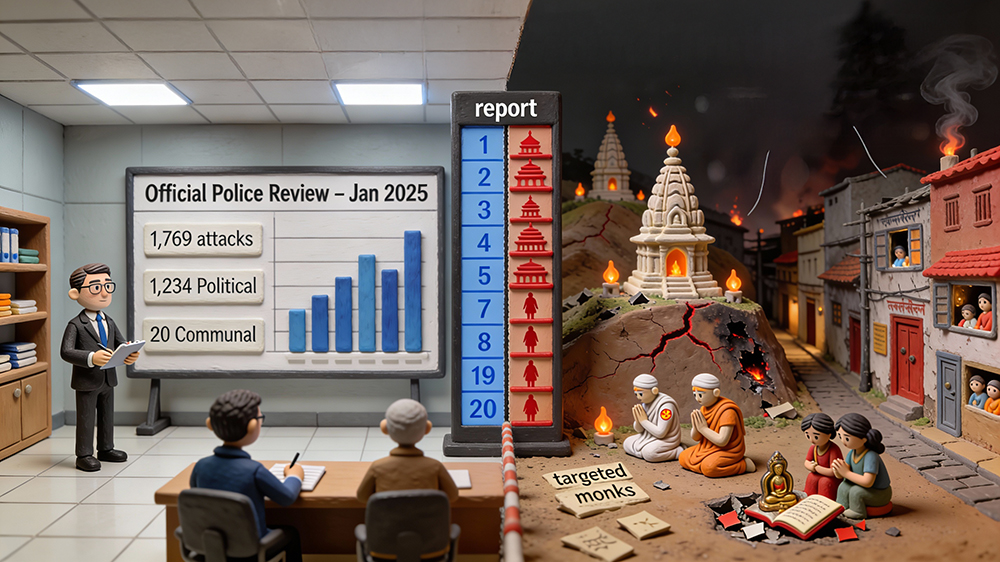
The interim government under Mohammad Yunus has characterized the violence primarily as politically motivated rather than religiously targeted.
Bangladesh Police Force Analysis (January 2025)
In an official review of 1,769 attacks occurring between August 4 and 20:
- 1,234 incidents classified as “politically motivated.”
- 20 incidents deemed “communal in nature.”
Human rights organizations dispute this characterization, pointing to evidence that contradicts purely political motivations. They note that 69 temples were destroyed—religious structures with no political function. Religious leaders and monks with no party affiliations were targeted. Hindu-majority neighborhoods without Awami League presence experienced attacks. Additionally, cases of forced conversion attempts have been documented, which human rights groups argue indicate religious rather than political motivation.
During a UK Parliament debate, one member observed: “The clear issue is an attempt at ethnic cleansing of Hindus from Bangladesh.”
Testimonies from Affected Communities
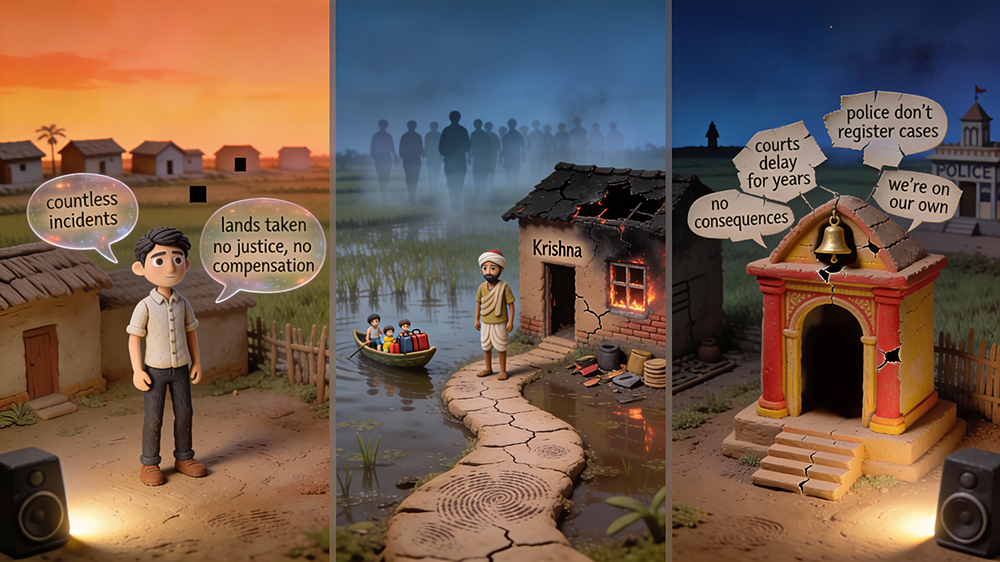
“There have been countless incidents of violence and persecution. Many Hindus were displaced, and lands were forcibly taken. It’s unclear whether they’ve received justice or compensation.”
— Abhro Shome Pias, 27, engineering student
Krishna Das, a farmer from Sunamganj, stood outside his damaged home after mob violence erupted following a blasphemy accusation on social media. His family fled, fearing for their safety.
“We don’t report attacks anymore. Police don’t register cases. Courts delay for years. Perpetrators know there are no consequences. We feel we’re on our own.”
— Temple priest, identity withheld for safety

Regional and International Dimensions
India’s Response
The Indian government has responded to the situation through several mechanisms. The Citizenship Amendment Act (CAA), passed in 2019, provides expedited pathways to Indian citizenship for religious minorities, including Hindus, fleeing persecution from Pakistan, Afghanistan, and Bangladesh. The Modi government has also raised minority protection issues in bilateral discussions with Bangladesh.
Limited International Attention
Despite the scale of documented violence, the international response has been limited. Two U.S. congressmen, Shri Thanedar and Raja Krishnamoorthi, urged intervention, but the State Department issued only general statements. The UK Parliament held a debate after constituent pressure, but no concrete policy changes followed. The United Nations has issued general condemnations without establishing specific monitoring mechanisms.
Analysts suggest that strategic interests in the Bay of Bengal region, competition for influence against China, and reluctance to antagonize Dhaka during broader geopolitical competition have contributed to the muted international response.

Global Context: Vulnerable Minorities Worldwide
The situation in Bangladesh reflects broader global challenges in protecting religious and ethnic minorities. Similar patterns of vulnerability exist in multiple regions:
Middle Eastern Christians
Iraq’s Christian population declined from approximately 1.5 million in 2003 to under 250,000 by 2024. Syria saw roughly half its Christian population flee during the civil war. Egyptian Coptic Christians face periodic church attacks.
Rohingya Muslims in Myanmar
Over 700,000 Rohingya fled Myanmar’s 2017 military crackdown, described by the United Nations as “textbook ethnic cleansing.”
Muslim Minorities in Europe
Islamophobic attacks increase following terrorist incidents, and far-right political movements have gained power partly through anti-Muslim platforms in several European countries.
These cases share common elements: vulnerable minorities caught between majoritarian street violence and weak or complicit state protection, with mainstream politics often paralyzed or unwilling to act decisively.
Context: Violence Under Previous Governments
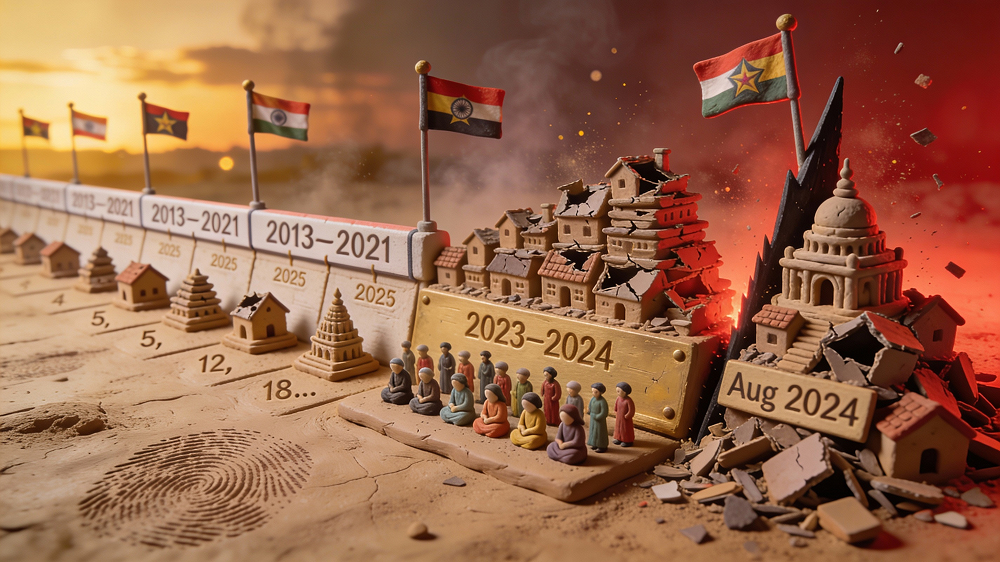
Violence against Hindu communities is not new to Bangladesh, nor limited to any single government. Ain o Salish Kendra, a prominent Bangladeshi human rights organization, documented 3,679 attacks on Hindu communities between 2013 and 2021 during Sheikh Hasina’s Awami League government, which was generally perceived as more protective of minorities.
Between June 2023 and July 2024, 45 murders of Hindu community members were documented. This historical context demonstrates that while the August 2024 spike represents an intensification, the underlying vulnerability of Hindu communities has persisted across different political administrations.
Human rights researchers note that the current crisis represents a quantitative increase in violence rather than an entirely new phenomenon, suggesting systemic rather than government-specific causes.

Challenges in Verification and Reporting
Accurate documentation of communal violence faces several obstacles. Disputed death tolls, difficulty accessing affected areas, victims’ reluctance to report incidents for fear of retaliation, and the politicization of information all complicate verification efforts.
The figures cited in this article come primarily from local Bangladeshi human rights organizations including the Bangladesh Hindu Buddhist Christian Unity Council and Ain o Salish Kendra, which have established track records of documentation. However, the Bangladesh government disputes some statistics, particularly regarding death tolls.
Independent verification remains challenging, underscoring the need for international human rights monitoring mechanisms with access to affected areas.
Looking Forward
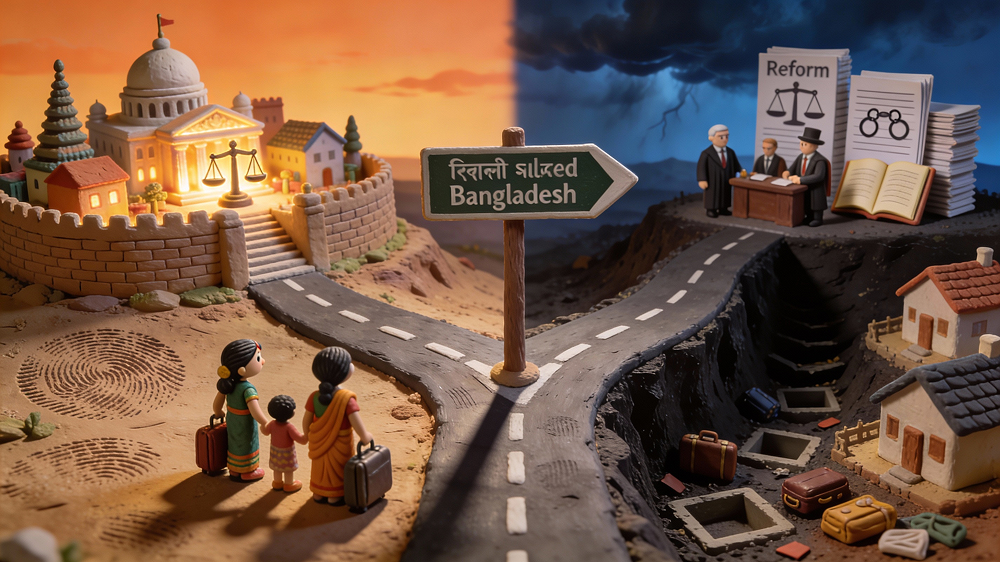
The documented violence against Hindu communities in Bangladesh during 2024-2025 represents the most severe period of communal targeting since 1971. Whether this marks a temporary spike during political transition or signals deeper structural problems will depend on several factors: the interim government’s ability and willingness to protect minorities, the reform of law enforcement and judicial responses to communal violence, international pressure and monitoring, and Bangladesh’s success in implementing the secular principles established at its founding.
For Bangladesh’s approximately 13 million Hindu citizens—representing less than 8% of the population—the immediate concern is physical safety and property security. The broader question facing Bangladesh is whether it can build institutions strong enough to protect vulnerable minorities regardless of which party holds power.
Human rights organizations continue to call for independent international investigations, strengthened legal protections for minorities, police and judicial reforms, prosecution of perpetrators, and compensation for victims. Without sustained attention and concrete action, observers warn that the historical pattern of demographic decline may accelerate, with implications for Bangladesh’s social fabric, regional stability, and international standing.

Frequently Asked Questions
How reliable are the documented statistics?
The statistics cited come from established Bangladeshi human rights organizations with track records of documentation: the Bangladesh Hindu Buddhist Christian Unity Council and Ain o Salish Kendra. However, the Bangladesh government disputes some figures, particularly death tolls. Independent international verification would strengthen confidence in the data.
Is this violence primarily religious or political?
This remains contested. The government characterizes most incidents as politically motivated, targeting Awami League supporters who happen to be Hindu. Human rights groups argue that the destruction of temples, targeting of religious leaders, and attacks on non-political Hindu communities indicate religious motivation. The reality likely involves both political and religious dimensions that are difficult to separate.
Why don’t affected families simply migrate to India?
Migration requires significant resources that many rural Hindu families lack. They must sell property—often at distressed prices—cover travel costs, navigate bureaucratic processes, and establish new livelihoods while leaving behind social networks. Legal immigration takes years, while illegal crossing risks arrest. For impoverished families, migration is financially impossible despite safety concerns.
What was different under the Hasina government?
Under Sheikh Hasina’s Awami League government (2009-2024), Hindu communities experienced relative stability compared to other periods, but Ain o Salish Kendra still documented 3,679 attacks between 2013 and 2021 and 45 murders between June 2023 and July 2024. The current interim government period has seen an intensification of violence, but the vulnerability of Hindu communities has persisted across administrations.
What could effectively protect minority communities?
Human rights experts emphasize the need for structural reforms, including an independent judiciary with enforcement power, police accountability for failing to protect minorities or register cases, repeal of discriminatory property laws, swift prosecution of communal violence perpetrators, and constitutional protections with actual implementation mechanisms. International monitoring and pressure may also play a role.
Sources:
- India-Bangladesh Relations: Historical Analysis and Future Challenges
- Citizenship Amendment Act: Complete Guide to CAA Provisions
- Religious Persecution Worldwide: 2024 Global Report
- Partition of India: Legacy of 1947 Borders 75 Years Later
Sources: Bangladesh Hindu Buddhist Christian Unity Council, Ain o Salish Kendra, Human Rights Watch Bangladesh, UK Government Country Report Bangladesh, UN Human Rights Office, Wikipedia verified entries, Al Jazeera investigations, International Christian Concern reports
“All images in this article were generated using AI tools for illustrative purposes. They are designed to visualize concepts and should not be considered actual product photographs.”